|
Venezuela - Summary, 21st August 2007
We spent 3 weeks in Venezuela in August 2007 and concentrated on the National Parks in the east of the country: the Orinoco Delta, Cainama & Angel Falls and Roraima. Of course like most tourists we were concerned about security but must say we never had any negative experience and never met anybody who had.
Venezuela’s main assets are its national parks and its natural wonders. We would rank Roraima top even though physically highly challenging, then Canaima & Angel Falls, actually a must when visiting Venezuela, and the Orinoco Delta. To visit the last one only pays off if you stay a Warao village and watch the activities all day. Travelling up and down one of the many rivers in the delta is exciting in the beginning but becomes rather boring, since the scenery does not change much. Also there is not a whole lot of wild life to see. We did not go to Merida, but only heard positive comments about it. We also did not spent time on the beach.
Since anybody visiting Venezuela will go through Ciudad Bolivar, to stay at Posada Don Carlos is a must, we talked to people who traveled most of South America and said that this is probably the best budget accommodation to be found. Otherwise it is a strange city, streets are deserted by night and the locals spend the evenings / nights on the river bank, drinking beer from coolers and listening to their stereos built into the trunks of their cars, the volume is usually deafening.
This kind if entertainment we observed already right after our arrival in Venezuela. We spent the first night at the Hotel Catima near the airport in Caracas, a good option. Immediately after we stepped out of the hotel we noticed two local peculiarities that would accompany us throughout Venezuela. The ever present garbage on the street and the loud music coming from speakers sometimes meters high. Venezuela seems to lack an efficient system to collect garbage and what’s more, most people seem to accept that any kind of garbage is dropped anywhere anytime.
Transport between cities is very easy, very modern busses carry passengers across the country, the fares are extremely low. BUT: bring warm clothes or a sleeping bag, the temperatures are similar to those in a fridge, we are not exaggerating.
Budget accommodation and cheap food is not problem to be found and even tours can be organized for little money while getting to see the same as those who paid twice as much. This is especially true with the black currency market that is widespread in Venezuela: you can get up to 3.900 Bolivares per USD against 2.150 on the official market and with credit cards - Bring USD cash, bigger notes get you a better exchange rate.
The local alcoholic drinks are beer and rum and of course the usual soft drinks. We came across very few places serving fruit juice, if then in Brazilian eateries near the border. The fruits, except bananas, offered in shop look rather poor and most locals prefer “arepas”, “empanadas”, rice, beans and chicken or meat. Fast food found in food stalls, bus stations, etc, … is always deep fried. The consequences of this diet on the people are obvious throughout the country, the fact that portion are simply enormous contributes further to the problem. When entering Brazil we were simply struck by the difference.
Venezuela - Budget, 20th August 2007
Venezuela is a very cheap country to travel, especially if you use the black currency market that is widespread.
The inflation is high and therefore has lead to a de facto strong devaluation of the Bolivares, the national currency. Since Hugo Chavez decided a fix parity to the US Dollar (1 USD = 2.120 Bolivares), a black market has developed for trading the USD, the Euro or the Brazilian Real. This black market is everywhere, and even the police at the airport offers the tourists to change money, even though they do not propose a good rate (3.000 Bolivares for 1 USD).
On the street, you can get up to 3.900 Bolivares per Dollar. We only got up to 3.700 but we had made the mistake of taking small notes whereas bigger ones, especially 100 USD, are much more in demand and get you a better exchange rate. This system enables you to pay actually almost half of the price for everything. And with a very strong Euro against the USD, the exchange rate turned out to be even better for us!
The only problem is that we had to carry a lot of cash … enough for the three weeks in Venezuela, which meant 2.000 USD. This can be considered as a major risk. But we have neither been confronted with security problems, nor met someone who personally had been confronted with it. But of course we would hear the most horrible stories of someone who met someone who heard about someone who had eventually been mugged or robbed …
During the 3 weeks we spent there, we spent 710 Euro per person, and we did not travelled really on a budget: we flew from Caracas to Ciudad Bolivar to avoid getting into Caracas, we treated ourselves to a few pricier Posadas or Hotels (Posada Angostura in Ciudad Bolivar & Hotel Lucrecia in Santa Elena), we did not particularly pay attention to what we paid for food and drinks and we booked three tours for a total of 13 days: the Orinoco Delta, Canaima & Salto Angel and Roraima, which made up 60% of the total budget.
Roraima Trekking, 19th August 2007
Trekking Mount Roraima was definitely one of the highlights of our trip in Venezuela, but it was also the toughest 6 days we ever had during a trip. This had to do with the fact that we were untrained and that the weather conditions were partly extremely difficult.
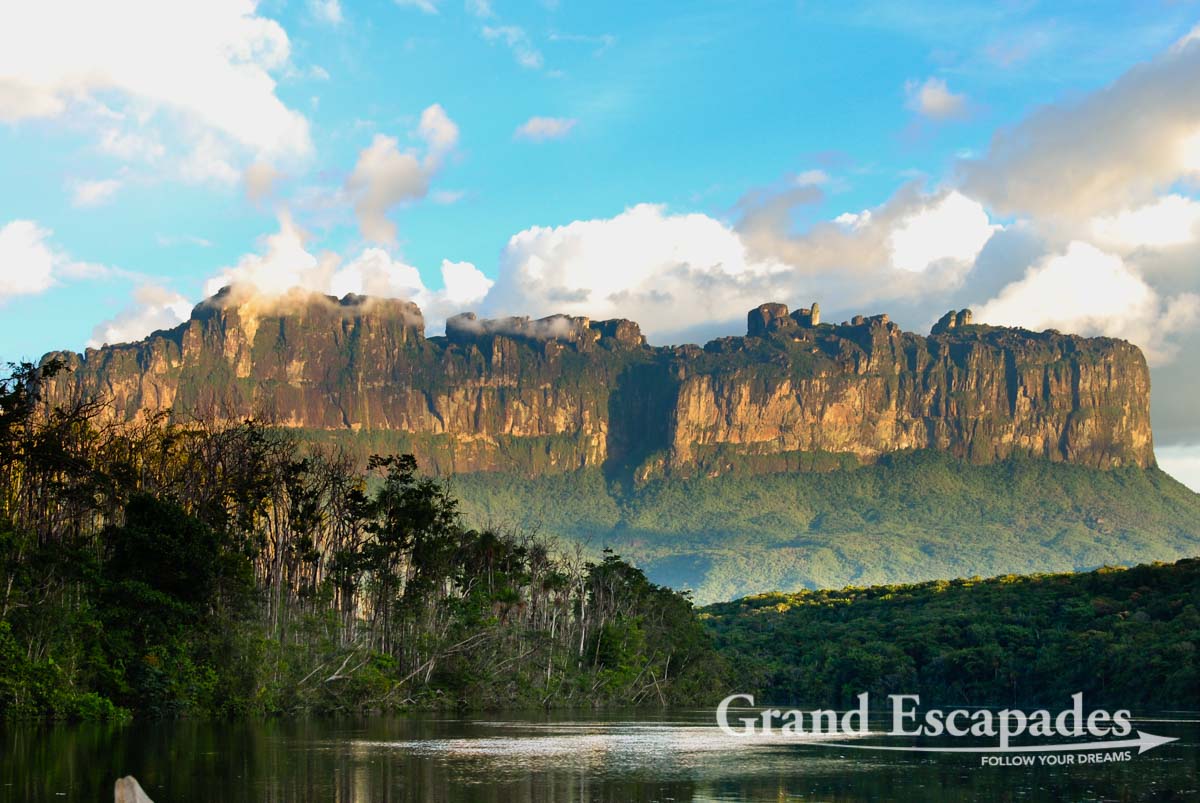
Climbing the top of the Tabletop Mountain or “Tepuí” Roraima involves 6 days / 5 nights of trekking: the first two days are relatively easy, walking through typical Gran Sabana scenery: green savannah grassland intercepted by small woods, the most pleasant and peaceful landscape to imagine. The only dark side of the Gran Sabana are the millions of “Puri Puri”, small flies that sting like mosquitoes, but are not deterred by repellents, but only long leaves and long pants. They are especially active at dusk and near rivers.
The third day starts out at the foot of the vertical cliff, with the painful ascent of “The Ramp”, a small and steep path that takes you 1.000 meters further up to the top.
We do not want to go into depth how we felt during the way up but try to give more general information. Firstly, luckily Heidi decided the very last minute to have her backpack carried by a “Portero”, for about 14 USD or 50.000 Bolivares a day, whereas Gilles carried his 12 kilos for 6 days.
Secondly, after being up the Tepuí it is clear at least to Heidi that Mount Roraima is a destination for the dry season. We were extremely lucky to have nice weather for the first three days but were completely rained in on top. The landscape on top is a formation of rock boulders and swampy patches, and after heavy rain, the puddles between the rocks are getting bigger and the distance between the rocks wider and wider and eventually it becomes almost impossible to jump from rock to rock. Please do not forget you are doing this jumping on slippery, wet rocks! Most likely you are wearing the same clothes that you will wear during the night, since the low temperature on top during the night might require you to wear ALL your clothes.
Of course rain is part of Mount Roraima, which is usually hidden by clouds and fog. The atmosphere created by the fast moving clouds and fog is indeed fascinating but we are convinced that having a view from the top of the Tepuí and not walking under heavy rain is a lot more pleasant than the way we did it. But the scenery on top of this Tepuí is simply breathtaking and definitely worth the trekking.
The surface of the Tepuí Roraima is about 250km2 which is huge. Therefore, the area that most tourists explore is relatively small. Some trekkers are ambitious enough to head for “Triple Point”, the frontier between Venezuela, Brazil & Guyana, on top of Mount Roraima. It is only 9 km each way but takes 8 -10 hours of trekking, which tells you everything about the difficulties moving around. With the bad weather and limited visibility the day we spent on top, the question whether to try it didn’t even arise in our group. Instead we visited the area near our “Hotel”, which contains lots of highlights. Evening activities up the mountain are simple: at 06:30 pm you gobble down your dinner, standing up, since there is no possibility to sit down and at 07:00, latest 08:00 pm you are in your tent.
Towards the end of our day exploring the top Heidi was getting very tired and fell behind, Gilles and one of the Porteros stayed with her. At 04:00 pm we found out that we were lost, Heidi had very strong feelings. To give you a picture, at 06:00 pm it is completely dark and you are surrounded by water and rocks. In the meantime Jose was getting very worried and started searching for us, when we finally saw him standing on top of a rock waving his arms we all were so relieved.
The toughest part of the trekking is the fifth day, getting down the ramp and trekking back to Camp Tök, the camp where we stayed the first night. This means covering the same distance as day 2 and 3 and a difference in altitude of no less than 1.800 meters, a real physical challenge since getting down is also extremely tiring.
Apart from that, staying concentrated was crucial because every mistake / injury can turn into a major problem, since there is no security measure and no evacuation scenario whatsoever. People with an open fracture had to be taken down in hammocks, which can last up to 36 hours: the few helicopters that are available in this area are owned by private tour operators, which give priority to excursions flights instead of to rescue operations, even though a helicopter rescue costs 1.600 USD.
We followed the recommendation of several people we had met and went with Mystic Tours. This was a very good choice! First, because our guide, Jose, was outstanding - a very strong but very nice personality, very knowledgeable and extremely funny … Second, because we were in a small group only with Spanish people speaking almost only Spanish, which compelled us to work our Spanish a great deal. And last but not least for material reasons: the tents were big, carried and set up by the porters, which was not the case with another company that charged the same price. After a 5 to 8 hours walk this is definitely no luxury!
The owner of Mystic Tour, Roberto Marreno, is studying supernatural appearances on Mont Roraima and explained us with passion why this place is so special, comparable to Machu Picchu and what not … There have been more than 200 supernatural appearances near Roraima in the last years, which Roberto Marreno all listed and analysed. At least we followed his recommendation and, as the Indigenous do, “ask the mountain for permission” before starting the trekking: “We come in peace, we come in harmony, and we ask for permission to climb the mountain”. We cannot say if it helped or not, but at least we are back in one peace …
A few days in Santa Elena de Uairen, 18th August 2007
A twelve hours bus night ride from Ciudad Bolivar brought us to the small settlement of Santa Elena de Uairen on the Brazilian border. The “Buscama”, the busses linking major cities in Venezuela, are highly comfortable, but, as we might have already mentioned, the temperature inside is 14 degrees, now having this artic breeze hitting your body for 12 hours can be challenging. Even though we wore all the warm clothes we had, we were freezing!
The only reason to stop in Santa Elena de Uairen is to prepare a trekking to Roraima, the highest Tepuí with almost 2.800 meters or trips to the Gran Sabana. Nevertheless we planned to rest here for three days to recover from the trips to the Orinoco Delta and to Canaima / Angel Falls. We treated ourselves to the very comfortable but also pricy Hotel Lucrecia, its pool we unfortunately only could use once because of the rather chilly weather.
As it turned out we could not have left earlier for Roraima anyway because the trek was closed for the first time in its history. Two days before our arrival a porter had drowned in a flooded river. The group had insisted on crossing against the guide’s warning.
We passed the time exploring every corner of the village and trying various eateries, this way we discovered the popular “Comida per kilo”, a Brazilian custom. A good deal we spent in internet cafés and sorting our many photos.
Santa Elena is close to the gold and diamonds mines of Paují, shops were these commodities can be sold are numerous in the village. Many “Indigenous” work in the mines and the work is excruciating, probably one of the reasons why heavy drinking is such a common sight in this place. We found out that one liter of the cheapest rum only costs 6.000 Bolivares, which equals about 1.5 USD.
While we were on Roraima and the even the days after our return the whole village was partying in the honour of its patroness Santa Elena. Unfortunately, this meant loud speakers playing at max. volume all night long and people getting dead drunk on the street. Nothing really exciting, and even on the last day, when we decided to try harder and join the party, we very soon gave up and went back to our hotel only to listen an incredible amount of decibels till the wee hours ...
Angel Falls, 11th August 2007
Everybody seems to know Angel Falls, the highest waterfalls in the world with 979 meters, named after the daredevil pilot who first saw the falls when flying his plane into “Canon de Diabolo”, but the smaller waterfalls in the Canaima Lagoon are equally sensational in a different way.
It was these places that we visited first in a small boat right after arrival, Salto Ucaima and Salto Hacho. We took then a walk towards Salto Sapo. There, a small passage was carved from the rock that takes you behind and to the other side of the waterfall. This “behind-the waterfall walk” was very impressive. The immense energy of the water pouring is incredible: it felt as if the whole passageway was trembling and we were showered all the way through. Heidi was pretty scared.
We then continued crossing another plateau of breathtaking savannah scenery and then were met by our boat that took us up Rio Carrao towards our first Campamento, Aonda Lodge. Minutes after we left the motor of the boat gave up and help had to be summoned. It was already dark when we travelled up Rio Aonda that branches off Rio Carrao and a bit worried that the engine could give up again on that stretch of the river in total darkness. Equally exciting was our arrival at the Campamento, we climbed from the boat unable to see anything and stumbled towards the Campamento. After a quick dinner and a brief chat with our fellow travellers we retreated to our hammocks, since there was not much else you could do.
By morning the sun was out again and we continued our boat trip towards the next Campamento on Isla Raton. This is one of the best and closest camps to Angels Fall. It is as basic as the other one, but you can see the fall from the camp which it not possible from many others. This is important because during the rainy season the waterfall is often covered by clouds or fog and sometimes can only be seen for a few minutes. If you have to travel to see it from a camp far away, it may happen that you do not see anything. But we had all day to wait for the clouds to move and actually were able to view the entire waterfalls for a few hours.
There is a viewpoint even closer, which can be reached after a walk of about an hour. The walk through the woods is very picturesque, but although we had sunshine all the way up, the weather changed within minutes and when we finally got to the “Mirador”, the falls was completely hidden behind clouds.
After spending the night there we went back to Canaima early in the morning, because all the other were leaving the same day by plane back to La Paragua and Ciudad Bolivar. Luckily we had decided to stay one more day and spent the night in the Campamento from Tiuna right on the lagoon. We could see Salto Ucaima from our hammocks and having now showers and electricity made us feel like living in a five-star hotel. We explored Canaima village, where there is not much to see. The highlight is the lagoon with its small but beautiful sandy beach and the backdrop of Tepuis and waterfalls. We felt happy that we had stayed and had a chance to absorb this incredible scenery at our own pace. Not many tourists seem to stay in Canaima, except in the top lodges, which are really luxurious but extremely expensive as well.
Our dream of having a beer in a nice place after all these days outdoors was not fulfilled, because there was not such thing. We tried one of the expensive lodges, but 10.000 Bolivares for a beer seemed a bit much. So we shopped at the only store and went back “home” to enjoy the electric light and start writing our reports. The next morning, we went back to the beach for a swim and afterwards went straight to the airport were the plane was already waiting for us.
Canaima National Parc, 10th August 2007
After the three days in the Orinoco Delta and the long travel back to Ciudad Bolivar via Ciudad Guyana, we longed for a little rest and comfort … Unfortunately the comfortable and most pleasant Posadas such as Don Carlos or the more expensive Angostura were all booked out. So we had to take what was available, which was Posada Dona Carol. Considering we would not find any pleasant rest, we decided to book a tour into Canaima the next day. We followed the recommendation of other fellow travellers and went to Total Adventura.
First advantage, Total Adventura is far cheaper than any other company: 200 USD per person for the classical 3 days / 2 nights tour against 250 to 350 USD at all other agencies. And we could book a hammock free of charge for an extra night in Canaima at their Campamento, which we actually did. On top of that, we could sleep in their Posada for free the night before and the night after. The Posada was quiet stuffy and hot, but had vans. We also could use the washing machine to do our laundry. Since we were the only guests it was not too cramped.
Actually Total Adventura is only a reseller. They sold us a tour with Tiuna Tours, which turned out to be an outstanding choice. First, our guide, Miguel, was very experienced & very knowledgeable. But the main advantage is the location of their Campamentos. In Canaima, the camp is directly on the Laguna, with a view of Salto Ucaima. The place is airy and clean with facilities and a little restaurant. Even more important is the position of their camp near Salto Angel: it is located on Isla Raton, with a 50 meters walk to a great view of Angel Falls. This is crucial especially in the rain-season from Mai to November because you will only seldom get to see the complete waterfall, which is often hidden behind clouds or fog. So if you have half a day to a full day in a camp near the falls, your chances are much higher to get a good view. But only few of the groups with Tiuna Tours go to the camp on Isla Raton, so once more we were lucky!
So on Sunday, August 5th in the morning we headed towards Canaima. One of the reasons for the lower price is that we drove 2.5 hours to La Paragua and took a plane from there. The flight takes about 25 minutes on a small, 6-seaters Cessna plane including the pilot, sorry, “El Capitan”. The more expensive tours fly directly from Ciudad Bolivar, but that alone costs an extra 40 USD per person.
The plane ride alone was an experience: it feels strange to be squashed into this metal box running on one engine. Heidi was definitely glad when we touched down. To make a point el Captain started reading the newspaper when we had reached our cruising altitude of 3.500 feet, of course in a plane without auto-pilot … The approach in Canaima was absolutely spectacular, with a beautiful sight of the Canaima-Laguna and the various water falls. Last but not least, El Capitan decided to fly along the runway, make a very sharp turn and land the plane just seconds after he had finally stabilized it … Quite impressive! Of course on the way back the other “Capitan” had to impress us with an even more daring approach with an even sharper 180 degrees turn right before the touch down …
Our lucky streak continued on that tour. The group that left before us counted not less than 45 persons and the group after us about 35 tourists. We were only 9 people: apart from us, a Hungarian couple on their honey-moon, two Dutch students and 3 Spanish guys who had traveled everywhere on this planet.
The Orinoco Delta, 9th August 2007
We truly enjoyed watching the activities in the Warao village from sunrise to sunset and sleeping in hammocks overlooking the river, even though this is not the most comfortable way to spend the night. The dwellings of the Waraos are perfectly adjusted to the climate, a wooden platform with four pillars that carry a thatched roof, so there is always a nice breeze and almost no mosquitoes. This is due to the fact that the many rivers that feed the Delta are so called “Rios Negros”, which carry an acid that is obviously not a habitat that mosquitoes prefer.
The Waraos use their native language and children only learn Spanish once they start school. Bernard, our fellow traveler, one morning organized a lesson in Warao for him, which was enchanting to watch, with the older kids translating into Spanish.
The Waraos have big families, lots of children play together and take care of each other all day. Once we watched a two-year old kid falling off the blanks that connect the houses on stilts and ending up in the swamp a meter below. The other kids simply pulled him out, took him to the river and washed off the mud. No adult intervened, except us following them anxiously.
Although the village has a generator that is turned on for four hours in the evening, life pretty much is determined by sunset and sunrise. With electricity available, naturally TV determines the evenings of the families. They sit together on the floor and watch Venezuelan programs and even sometimes DVDs.
The Delta is the natural habitat of a huge variety of animals. We got to see red monkeys, dolphins, parrots and other exotic birds, but the stay in the Waroa village was exceptional. “Warao” means the people of the water and this is exactly how they live. We spoke to other travelers who stayed in “Campamentos” in the middle of nowhere, suffering from mosquito attacks and completely isolated from the local community. They surely missed THE highlight of the trip!
The only thing that bothered us was the many roosters of the families which woke us at 05:00 o’clock and would not stop for hours. We were making jokes about eating the “Gallos” for dinner. The gossip must have reached them, since they were definitely less active the next morning!
The second day we did a long boat trip to the estuary of Delta especially to see an Ibis colony, which are indeed beautiful red exotic birds. If we did the trip again we would simply stay in the village, because this trip takes hours and the banks of the river look very much the same.
One of the first things that struck us was plants that were floating on the river, but to our surprise they were moving upriver and then down the river. It took a while until we figured out that this movement was influenced by the tide of the near ocean, with water level increasing or decreasing by more than one meter.
The few hours that electricity was available we used to download photos to our computer and sort them out. This turned out to be a major attraction for the kids of the village since they could see their photos on the computer.
We have mentioned the issue of collecting litter before, but here, in these remote villages it was even more obvious, plastic garbage everywhere. The method to deal with it is to collect it and burn it in the woods by pouring gasoline for it. Rather disturbing was to see how animals are treated. The dogs straying the villages are near starvation and not a pretty sight and we almost felt nauseous when we watched the joints to all these crabs being broken so that they cannot pinch anymore and were left like this until to be cooked.
Tucupíta & Going to the Orinoco Delta, 8th August 2007
From Ciudad Bolivar we took a bus to Ciudad Guayana and then a “Por Puesto”, a collective taxi to Tucupíta, the only major settlement in the Orinoco Delta. At our hotel, the Amacuro Hotel, we arranged a trip into the Delta with a local “Pirata”. These are independent guides not working for an official agency, which were almost all closed due the city celebrating its 159 anniversary the day we arrived. Another reason was the major price difference between the two: we negotiated 500.000 Bolivares per person for a classical 3 days / 2 nights tour, while an official agency offered us 900.000 Bolivares.
The anniversary celebration drew throngs of people to the river banks where vendors sold beer and delicious food. Of course every 50 meter you had a speaker playing at max volume. In the beginning we thought we were approaching a band playing but it always turned out to be a stereo.
We were extremely luckily in many ways. First of all our group only consisted of three people, Gilles, Heidi and Bernhard, a German who spoke fluent Spanish, which helped a great deal. Second because we were guided by Luis, the most experienced guide you can wish for. He knew every plant, animal and also cooked delicious meals. The amount of food served has been simply too much for us, but obviously normal for Venezuelanos, maybe this is one of reasons why we find most people here simply overweight. Luis brother Antonio was the captain of our little boat, which had two engines, as required by law, but no roof to protect us from the rain or sun, which at times would not have been a luxury.
The morning we left, we drove for three hours in torrential rain. We were soaked to the bone despite our raingear. Our lucky streak continued and by noon the sun was shining again. We stopped for lunch which Luis prepared over a camp fire. It was incredible what he produced under such conditions, at this point we knew we were in good hands.
In the late afternoon we arrived in a Waroa village, where we spent the next two days and nights. The Waraos are the local “Indigenos” of the Delta and have settled there for 500 years and mainly live of fishing. Observing the life in the Warao-village for these two days was the highlight of the tour, although there were no facilities whatsoever. Toilets were outdoors at the end of the village and taking a shower meant pouring a bucket of water over our head.
Just a little vacation ..., 7th August 2007
On Thursday, August 09th, when arriving in Santa Elena de Uairen after a whole night in a freezing cold bus, we will have spent the last 14 nights in 13 different places! The only time when we spent 2 nights in the same place was in the Orinoco Delta, in a Warao village. This is a little bit too much!
And of course most of those places were not exactly 5 stars palaces. When we had a shower, which has definitely not always been the case, it was almost systematically cold water. Many nights we spent sleeping in hammocks, only a roof over our head and the lodges in Canaima National Park didn’t even have any electricity. It might sound very romantic or exotic, but it is without a single doubt highly uncomfortable!
And of course we have not been lazing on the beach or close to a swimming pool … We have just finished the second tour in Venezuela: 3 days in the Orinoco Delta (a report will soon follow) and 4 days in Canaima & the Angel Falls (Salto Angel, a report will also soon follow). We also visited Ciudad Bolivar (see report from August 6th) and Tucupíta. This means also quite a bit of time in transports.
So what is next? We will indulge ourselves with 3 or 4 days / nights in a good hotel in Santa Elena and … Do NOTHING!!! Get ourselves and our stuff clean that will be tough enough, sleep and relax, read a little, sort the many pictures we have already taken, write the reports we should have already written. Finally, and maybe the most important point: during those days, we will not have to unpack & repack our backpacks every night / morning, which is strenuous and actually sometimes is the source of an argument! This little vacation in the trip will surely helps us loading up the batteries for some further adventures!
Afterwards comes serious stuff: 6 days trekking Roraima, the highest Tepuí or Tabletop Mountain, climbing up to 2.800 meters … with temperatures close to freezing at night, at least several hours rain per day and maybe worst, a few billion mosquitoes, or “plagas”, a local kind of mosquitoes that does not sting but bites and especially “puri puri” which are very small flies and that are not fought off by skin repellents.
, 6th August 2007
A one-hour flight from Caracas brought us to Ciudad Bolivar, the second largest town in Venezuela; though a dwarf compared to Caracas, the sprawling megalopolis with its 5 million inhabitants. Though we couldn’t get a room in so very popular “Posada Don Carlos”, we definitely enjoyed “Posada de Angustura”, a bit pricier but VERY comfortable. Nevertheless we used Posada Don Carlos for socializing with other travelers and seeking advice in various matters. This is the best place to stay in the whole city, a tastefully decorated posada with simple but clean rooms. The big asset though is its courtyard, quiet and airy, no other place in town offers this kind of atmosphere. We came here every evening to have a beer, gossip with fellow travelers or write down our impressions.
Ciudad Boliva’s incredibly picturesque historic center reminded us a lot of Trinidad / Cuba with its colorfully painted houses and windows framed with decorative iron-work. Apart from its interesting centro historico, Ciudad Bolivar is also the hub to travel the Orinoco Delta, to Canaima & the Angels Falls and eventually to Grand Sabana & the Roraima Tepuis.
Miraculously Ciudad Bolivar is deserted at night and it is almost impossible to find a bite to eat or place to hang out. The lady living across Posada Don Carlos has detected that deficit and has started a little cook-out from her living room. The problem is that she does everything from scratch, so if a couple of starving tourists drop in, it takes quiet a while to produce the very dinner, which is of excellent quality and enough to feed an army. Those who like to enjoy a cold beer in the evening are faced with the same problem, the small shops are sold out by 08:00 pm and bars are hard to find. The one that was pointed out to us only opened after a knock. The owner would only allow those in who he identified as a tourist or somebody he knew. “Para seguridad”, he explained. We are a bit confused about this security issue because we simply cannot judge how serious it is. Almost all shops have heavily armed guards who look bored, but nevertheless …
Apart from the lack of restaurants & bars in the evening, those places usually play music at a sheer deafening volume and room temperatures are only a bit above freezing. This is also true for overnight buses, where tourists desperately wrap in sleeping bags and locals comfortably sleep away in short sleeves. During such a bus ride passengers, including children, get to watch the most violent videos imaginable. Así es la vida en Venezulal !
After two weekends in Venezuela we kind of figured out how the locals party. They take their cars down to the Paseo Malecon, bring along a huge speaker, hook it to the car’s stereo and turn it to maximum volume and drink beer and rum. Street vendor provide the food, children’s toys and more beer. Every bottle or can is dropped on the floor where it piles up with other rubbish. Never have we been to a country where waste collection / treatment or awareness for it simply doesn’t seem to exist.
Easy arrival in South America, 30th July 2007
While preparing the travel, we were surprised how many warning we would read or hear about traveling in South America. It has been sometimes so bad that we might have turned a little paranoiac! What a surprise considering how easy everything has been until now …
The evening in Madrid was delightful, a city we have to visit again, but definitely not in the summer: the heat was purely unbearable! Jose-Luis & Carmen took us for a very nice walk in the city center and of course for tapas. We both really enjoyed the time there. Why Madrid? Because it is undoubtedly THE hub for traveling to South America: from there airfares are far cheaper than in any other European city. And the flight with Air Europe was ok, considering they are a low-cost carrier. Of course the food was not terrific, but we had enough leg-room, which is actually most important on such a long haul flight.
Arriving in Caracas Maiquetía was simply smooth: as soon as we left the restricted area, we were taken care of by the “tourist police”, which by the way changed us USD into Bolivaros. It was not the best rate you can get (3.000 Bolivaros for 1 USD against 2.150 official rate, but we have been told it is no problem to get 3.700 and even sometimes 4.000). But it was the first evening, we were jetlagged and not knowing how the Bolivaros bills looks like, we enjoyed “the security” and considered the extra price as a fair compensation for security.
The choice of the Hotel Catimar near the airport was an excellent one. The pick-up service, even though a bit pricey for 7.50 USD per way, definitely made things easier after a transatlantic flight. The evening in the hotel bar, surprisingly frequented by locals, was really enchanting, enabling us to our first chance to practice our Spanish. Eventually we opted for a one-hour flight to Ciudad Bolivar against an eight-hours bus ride.
That way we avoided the madness of Caracas and got a bit of a view of the Orinoco river when descending onto Ciudad Bolivar. Soon we discovered that we had chosen the “hottest city of Venezuela” as first base with temperatures above 40 degrees Celcius. Presently we are hiding in our room waiting for the cool down and being finally able to explore the historic center of Ciudad Bolivar. It reminds us a lot of th old colonial town of Trinidad in Cuba, with its colourful houses and tall window behind beautiful iron-works.
Tomorrow we will leave for Tucupita, where we will start our first tour into the Orinoco Delta …
The only point we have to take more care of is our budget, we currently have not succeeded to stay within our traveling budget … But this is surely a question of a few days to get used to our new type of life ...
Our Project, 1st July 2007
We land in Caracas but do not intend to stay one night in this city, then we will head straight east to Tucupita and start visiting the Orinoco Delta.
From there we plan to move on to Ciudad Bolivar to organize our visit of the Canaima National Parc and of course of the Angel Falls.
Afterwards, we will head toward Santa Elena de Uairén and trek the Roraima “tabletop mountains”.
|