13.09.2011
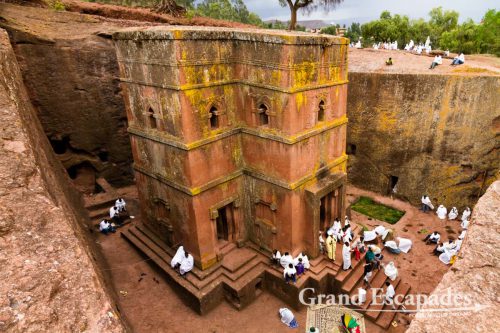
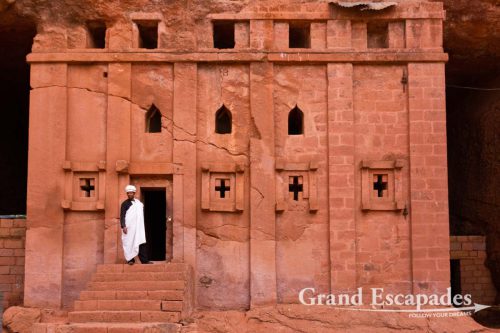
Ethiopia - The Northern Historical CircuitOur itinerary We have visited Ethiopia twice. The detailed account of our trip to the Lower Omo Valley and the Danakil Depression over the Christmas holidays 2010 - 2011 has been published on our website, on the website of the Lonely Planet & of the Bradt Guide and received a lot of attention. But we felt our Ethiopia experience was incomplete without exploring the great history of this country. So over Easter 2011, we followed what has become known as the “Northern Historical Circuit”. This term subsumes unparalleled highlights: Bahir Dar and the Monasteries of Lake Tana, the Royal Palaces of Gonder, the Stelae in Axum & the Rock-Hewn Churches of Lalibela.
Organisation With only 12 days in the country, we decided to fly between all major cities except Bahir Dar & Gonder, which takes only 4 hours by minibus on a good road. Having said this, all roads in Ethiopia are under construction thanks to Chinese money and engineers. Most only lack the final surfacing. As a consequence, overland transport in Ethiopia is due to change soon! We arrived with only one hotel reservation, for Lalibela over the Easter weekend and four plane tickets. The rest we organized ourselves in the country. This is very different to how the vast majority of tourists travel through Ethiopia. It is mainly groups large and small, in busses or jeeps that congregate at the best hotels in town and leave only with their guides to some tourist highlights. From this behavior Africans must conclude that white people do not walk! Tourists venturing out into town are treated like a true curiosity, like people who have lost their way. Not even the markets in Bahir Dar, Lalibela and especially Axum attracted visitors. Despite the staring, we enjoyed our extensive strolls and also met a few independent travelers on and off. The unique history of this once great empire and its many other attractions has led to a boom of high-priced tourism in one of the poorest countries in Africa. No wonder that a vast number of tour companies offer their services, hotels pop up like mushrooms and road construction is well under way. Ethiopian Airline, a highly modern airline, flies pretty much everywhere in the country. Most important, since April 2011 domestic flights for tourists have become a lot cheaper!
Perceptions proven wrong… Of course, there are still people who ask why you travel to a country at war and in the midst of a famine, when you talk about your plans of travelling to Ethiopia. At this we usually roll our eyes, but we equally proved vulnerable to wrong perceptions... Most travel blogs we read before our first trip dwelled on wild descriptions of “Faranji Fever”. This actually made us travel first to the Omo Valley and the Danakil Depression, hoping we would be less “exposed” there. Well, those a bit familiar with tourism in the Omo Valley know that nothing beats that place in terms of “Faranji Fever”. Actually, on the Northern Historic Circuit, locals and even children have become accustomed to tourists. School children in Lalibela even seem to have been trained to greeting them with “Welcome to Lalibela” and rattling off the name of every single capital city in Europe. Once, we played a nasty trick on a youngster claiming we were from Albania. The kid looked at us and answered “Tirana” without blinking! Talking about beliefs… Nowhere else did we encounter such an unbent national passion for legends, myths and martyrs. The Arch of Convent in Axum; the gory images of chopped off heads and tortured martyrs in the monasteries on the shores of Lake Tana; the deep religiousness, to name a few!
Budget Only beginning of April 2011 did Ethiopian Airlines stop charging overinflated “Faranji - Prices” on domestic flights. Having booked before April, we dished out a hefty 450 Euros for four domestic plane tickets per person. The mid-range to upper mid-range accommodation we chose cost on average 29 Euros per night for a double room. The more upper mid-range, the more large groups you have, if this is what you want to avoid. We never saved on food and more often than not chose nicer restaurants, which came to 7.5 Euros p.p. per day. To be honest, you can only eat so many Injeras… Everywhere, we hired a local guide at the local sights, which added 8.5 Euros p.p. per day to our budget. All in all? Except for flights, we spent 43 Euros on the Northern Historical Circuit p.p. per day. Considering our choices of hotels, eateries and activities, it was actually quite cheap…
The highlights of this trip?
Places we did not go Giving our limited time budget of 12 days, this was a tough decision! Of course we wanted to see Harar, so different from everything else, but it is a whole day’s drive from Addis. Yes, the rock-hewn churches of Tigray and a cozy night at the Gheralta Lodge were also on our wish list. But none of this would have fit into our 12 day itinerary. We briefly considered shortening our stays in Axum, Gonder and Lalibela by one day and trek the Simian Mountains. Eventually we decided against rushing through the historical towns and to be honest, we dreaded the cold nights.
Were there things we disliked or we would do differently?
Conclusion? The Northern Historical Circuit is a “Must-Do” when you are in Ethiopia and actually a succession of highlights. 12 days were actually too short, even when flying. So we sadly had to miss some of the more remote gems of this country. |